India EdTech Offline Expansion Puts Hybrid Learning in Focus

TL;DR
We find that India EdTech offline expansion reflects a hybrid learning shift, not proof that classroom delivery is always better. The ₹41,450 crore figure is an FY28 forecast for online higher education and upskilling, while learners should compare recognition, faculty access, complete costs, and the real function of any local centre.
India EdTech Offline Expansion Puts Hybrid Learning in Focus
India EdTech offline expansion has become a visible education-market signal, but the ₹41,450 crore forecast comes from a September 2024 exchange filing and refers to a defined FY28 market projection.
India EdTech offline expansion is a shift toward hybrid delivery: digital course access is being paired with local centres for teaching, tests and support. The FY28 ₹41,450-crore forecast covers online higher education and upskilling, not every coaching product. Students should judge each programme by recognition, teaching access, full cost and evidence of outcomes.
We explain what the forecast measures, why physical learning centres are scaling, and how to use the hybrid shift to make a smarter enrolment decision.
What the ₹41,450-Crore Forecast Actually Measures
The number sounds like a sweeping verdict on the entire education sector. It is not. The disclosure projects India’s online higher education and upskilling addressable market to rise from ₹13,200 crore in FY23 to ₹41,450 crore in FY28.
The Correct Growth Math
That path implies a 25.7% compound annual growth rate and an endpoint about 3.14 times the FY23 estimate. It is a projection, not audited revenue for every education provider, nor a guarantee that every course category will grow at that pace.
The Boundary Around the Number
The forecast concerns online degree programmes, certifications and professional upskilling. School tuition, entrance-exam coaching and classroom learning may overlap with this market, but they should not be added to the figure without evidence. We treat the number as context for a changing delivery model, not as a reason to assume that any specific programme represents value.
The Longer-Term Demand Context
India’s policy direction supports more higher-education and vocational access. The National Education Policy sets a higher-education target of raising gross enrolment from 26.3% in 2018 to 50% by 2035. That is a long-run access goal, not a quality stamp for an individual course.
Why India EdTech Offline Expansion Is Growing
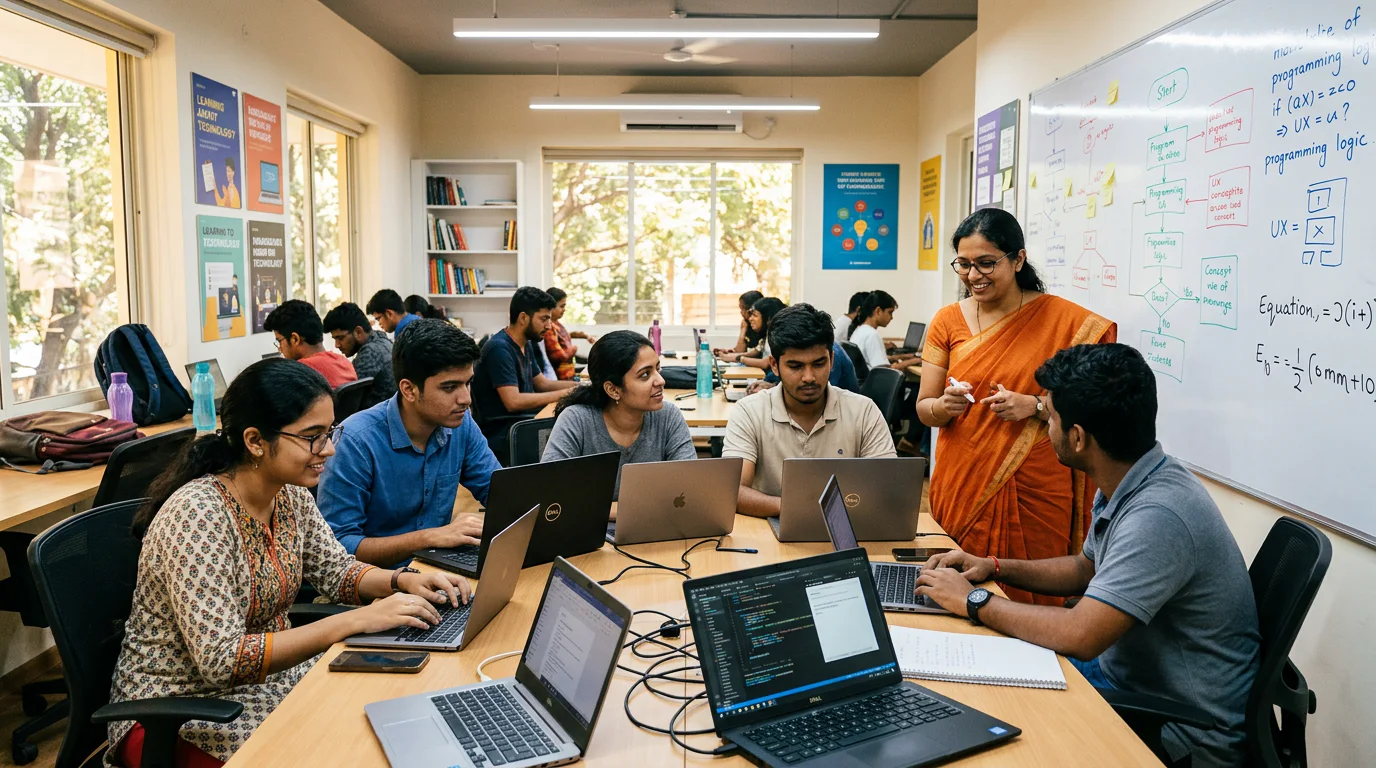
The clearest public evidence is that digital education businesses are adding physical capacity while retaining substantial online reach. A public prospectus recorded 303 offline centres as of 30 June 2025, showing that physical support is being used alongside, rather than instead of, digital delivery.
Centres Add Structure, Not Automatic Quality
A later exchange update recorded 314 centres as of 30 September 2025, alongside 0.40 million offline enrolments, up 26% year on year. Those figures confirm an operational expansion, but they do not show that every centre has the same faculty depth, teaching hours or student outcomes.
Access Still Shapes Format Choice
Digital access is improving, yet uneven. Ministry data shows that 63.5% of schools had internet access and 64.7% had computer access in 2024-25, according to official school data. For some learners, a nearby centre can provide reliable testing, routine and doubt resolution that a home-only plan cannot.
Hybrid Is the Inference, Not the Promise
We can reasonably infer that hybrid models appeal because they combine digital content with local accountability. We cannot infer that a centre is worthwhile merely because it exists. Learners comparing online coaching options should ask what happens there each week, not just whether the address appears in an advertisement.
How Learners Should Read the Hybrid Shift
The practical question is not whether online or offline learning wins. It is whether the support model fits your exam, schedule, budget and ability to study consistently. We recommend comparing the same evidence across every shortlist.
Verify the Credential Before Paying
For an online degree or recognised qualification, check the exact institution, programme and admission session. UGC tells learners to confirm programme recognition, review prohibited programmes and note restrictions on franchising arrangements in its UGC-DEB guidance.
Cost the Whole Experience
Ask for the tuition fee, materials charge, test-series cost, travel requirement, attendance policy and refund terms in writing. A low headline fee can become expensive if the course expects regular centre visits or excludes essential academic support.
Match the Centre to Your Constraint
A classroom can be useful when it solves a real problem, such as a missing study routine or limited home connectivity. It is less useful when it only adds travel without improving teaching access or feedback.
| Learner Need | Stronger Evidence To Look For |
|---|---|
| Study structure | Fixed class calendar, supervised tests and mentor availability |
| Better doubt resolution | Named faculty, response time and documented support hours |
| Flexible learning | Recorded lessons, accessible materials and clear attendance rules |
| Credential value | Programme-specific regulatory recognition and issuing-institution details |
For learners seeking regular in-person preparation, compare local teaching schedules, assessment support and total travel commitments. For study routines that remain online-first, build a weekly plan that matches the course’s live teaching and revision demands.
Find the Right Hybrid Fit with Onlinecoaching4u
At Onlinecoaching4u, we think the current hybrid shift makes comparison more valuable, not more confusing. We help learners start with the decision that matters: what format will actually support consistent study and a recognised outcome? Compare schedules, teaching access, programme recognition, fee terms and the real role of a nearby centre before you commit. If a course promotes a physical location, ask whether it delivers regular classes, supervised testing, mentoring or simply admissions support. Use our directory to shortlist options that fit your exam, career goal, city and study routine, then verify every claim with the provider before paying. Start at Online Coaching 4u.
FAQs on India EdTech Offline Expansion
Choosing the right delivery mode means separating market claims from the evidence a programme can show. These answers keep the decision focused on recognition, support and fit.
Is ₹41,450 Crore India’s Entire EdTech Market?
No. The documented figure is an FY28 forecast for online higher education and upskilling. We use it as market context, not audited current revenue across providers.
Does India EdTech Offline Expansion Mean Classroom Courses Are Better?
No. A nearby centre may provide routine, testing and support, but we recommend comparing faculty access, schedule, complete costs, recognised credentials and documented outcomes before enrolling.
How Can I Verify an Online Degree Programme?
Check the UGC-DEB list before admission, then confirm the exact institution, programme and academic session. We recommend reading prohibited-programme and franchising rules carefully before enrolment.