
Choose by Your Constraint for Online vs Offline Coaching
Online coaching
Live and self-paced programmes that can be joined from anywhere.
Offline coaching
In-person institutes with physical batches, browsed by city.
VerdictChoose online for remote participation, classroom for a reachable in-person batch, and hybrid only when the stated split solves both constraints.
Reviewed 15 Sept 2026
In brief
Choose online coaching when remote participation solves the student’s main location or access constraint. Choose classroom coaching when a reachable in-person batch is the requirement, then compare the specific course’s written total, timetable, language, doubt support, trial and terms before enrolling.
Choose Online coaching if…
- Your shortlist needs a programme that can be joined from anywhere.
- The provider can confirm that the remote course fits the learner’s device, connection, timetable and study setup.
Choose Offline coaching if…
- You need a specific in-person physical batch in a city you can realistically attend.
- The stated classroom delivery meets a requirement that remote or hybrid delivery does not meet.
Online coaching vs Offline coaching, feature by feature
✓marks the stronger side on that row — unmarked rows are a tie or a judgment call.
Where the course is delivered
Online coaching
Remote participation from anywhere, subject to the learner’s own setup and the course terms.
Offline coaching
In-person participation at a physical coaching batch.
Published delivery model
Online coaching
Online listings cover live and self-paced programmes.
Offline coaching
Classroom listings cover in-person physical batches.
Finding a physical batch near you
Online coaching
Remote availability is the relevant location feature.
Offline coaching ✓
Classroom institutes can be browsed by city.
Remote participation
Online coaching ✓
The format is designed for programmes joinable from anywhere.
Offline coaching
Attendance requires reaching the physical batch.
Where each one pulls ahead
Fees need a course-specific comparison
Use the written total and terms for the exact course instead of a national online-versus-offline fee estimate.
Accountability needs evidence
Confirm the actual attendance, homework, test, mentoring and follow-up process before enrolling.
Language, doubts and trials are provider-specific
Ask how the exact batch handles these details, and get the answer in writing where it affects the decision.
The format does not set the fee
Do not use a national “typical” online or offline fee to decide. Compare the written total for the exact course, including fees, taxes, materials, travel or stay where relevant, access validity and refund or cancellation terms. Use the online versus offline cost calculator alongside the coaching fee comparison calculator to make the comparison course-specific.
Connectivity is context, not a personal readiness test
As of March 2025, TRAI recorded 969.10 million internet subscribers in India, including 407.69 million rural subscribers, or 45.03 rural internet subscriptions per 100 population. Those are subscriptions, not proof that a particular student has a personal device, reliable connection or suitable study space. TRAI’s March 2025 telecom report provides the national context.
ASER’s 2024 rural survey of 14 to 16-year-olds found that 96.7% had a smartphone at home, while 35.0% of children able to use one owned one. Use that difference as a prompt to check the learner’s own setup before choosing a remote course. ASER 2024 is rural and age-specific, so it should not be treated as a coaching-readiness score.
Check the course before choosing the mode
A mode label cannot tell you the actual timetable, language, recording access, doubt process, trial availability or refund terms. Ask the provider for those details in writing, then select online, classroom or hybrid based on the constraint the course actually solves.
Course checks before choosing a mode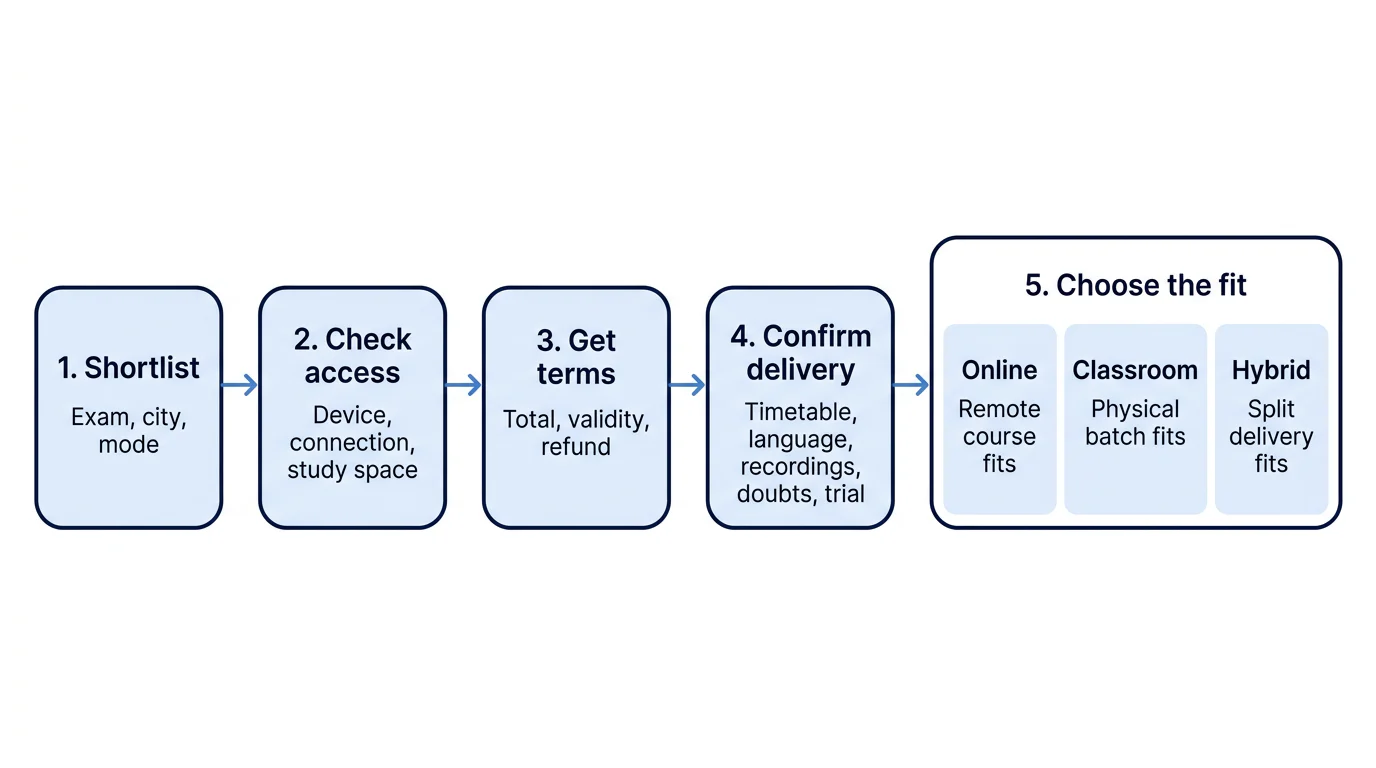
Do not buy a promise of selection
India’s CCPA coaching-sector guidelines apply to coaching advertisements and prohibit false or misleading claims, concealment of important information and assurances of guaranteed success. Treat rank, result and selection marketing as a reason to request course details, not as a substitute for comparing them. The CCPA’s 2024 guidelines set that standard.
Use reviews to prepare questions
A review can help identify what to ask, but it cannot confirm that a current batch will fit the student. Check the course, branch or online programme, delivery mode and terms before paying, then use coaching institute reviews as one input in the shortlist.
Keep reading


Frequently asked
Online coaching is not automatically cheaper than offline coaching because the relevant comparison is the written total for a specific course. Compare fees, taxes, materials, course-access validity, travel or stay where relevant, and refund or cancellation terms before deciding.
Accountability cannot be assumed from the mode alone. Ask each provider how attendance, homework, tests, mentoring and follow-up work for the exact batch, then choose the arrangement the student is realistically able to attend and use consistently.
Trial and demo availability are provider-specific, so confirm whether one is offered for the exact course and what it includes. A trial should help you inspect delivery, language, timetable and doubt access, not replace checking written fees and terms.
Hybrid coaching is worth considering when its stated split between remote and in-person delivery solves two real constraints, such as access to a course plus a need for some classroom sessions. Confirm the exact split, schedule and support process before enrolling.